Hello
Join us for something a bit different with live video auctions. Join us on Friday at midday (12pm) for an auction featuring wagons in OO gauge and N gauge, boxed and unboxed, available in singles or bundles.
Please note this goes through eBay for technical reasons, however this is sold by us at Upstairs Downstairs. You may even recognise a few faces on the screen!
Click on the picture for full details and to set a reminder.

Don't forget to read our latest modelling tips and unboxing videos located at the bottom of the newsletter.
Most images in this newsletter are clickable for more details.
Feel free to send this newsletter to your friends, family and club members if you think they will benefit from it. They can subscribe for free.
Railway song of the week
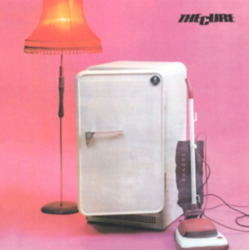
"The Subway Song" from The Cure is best described as an early post-punk track that captures the eerie, claustrophobic feeling of walking through a deserted subway station late at night. It features a sparse, repetitive bassline, train-like sound effects, and a notoriously startling, abrupt ending (you have been warned!). Click on the picture to listen to it:

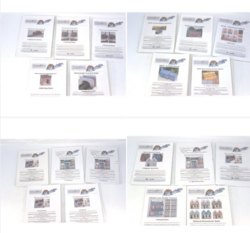
Model fences come in all shapes and sizes from numerous manufacturers. Woodland Scenics' range of fencing is described as "easily assembled". This means that they are ready painted and apart from spacing the fence posts a required distance apart, need very little doing to them before they are ready to be installed onto a layout. They are attached to a layout using the little spikes on the bottom of the posts called planter pins.
Most plots of land in real life have defined boundaries that are marked or protected by a wall, fence or bushes of some description. Choosing the correct one when creating a scene on your layout or diorama is as important visually as the land that they encompass and if not carefully considered there is often a temptation to use generic fences at every opportunity on your layout.
Below you can see how different types and styles of fence can tell a story. One of the pictures shows a barbed wire fence that can be used to surround a field on a farm as an alternative to a wooden fence. This starts to tell the story of the farm, maybe the farm is not doing too well and looks towards cheaper options for fencing, this suggests ideas of how the farmyard would appear and the state of any buildings on site. Alternatively the fence could be a temporary fixture to protect a new project or venture, the point is that when modelling a scene you can give a story to just about anything that will ultimately help you to give purpose, character and interest to the scene or scenes beyond. A barbed wire fence can also be used to help portray a wartime theme either at home or in continental Europe, this kind of diorama is becoming increasingly popular with wargamers and railway modellers alike.
Another good example of how different types or styles of fencing can change the appearance of a scene is with the difference between a split-rail-fence and a board-fence. Both these fences can be found in the British countryside but portray a clear difference in quality, age, affluence and purpose. Interestingly you can see these effects for yourself by clicking on the picture below and further clicking on the country-lane picture, there you can see a cameo scene of a country lane with a rather smart looking board-fence on the left of the lane and an improvised split-rail-fence on the right giving very different effects.
As you move closer to towns and cities the types of fencing used changes also, but the principles remain the same. A chain-link fence for example is typically found along the perimeter of a compound, lock-up, scrapyard, departmental railway land, builders merchant or anywhere else that requires security but not necessarily an aesthetically pleasing outlook. A chain-link fence is perfect for these kinds of environment because it's designed to be functional and cost-effective.
Trophy fences, however, have a much different purpose, they can often be found marking boundaries where security is not such an issue like on a residential estate, this means that more design effort can go into their appearance. A good example being a picket-fence. Most modellers are familiar with these as they have been modelled for decades especially around a station environment, but, in more modern times even homeowners are demanding a higher degree of privacy and security as demonstrated with the privacy fence. You can use the privacy fence convincingly along the rear boundary of most modern residential properties but glue a spot of barbed wire on the top of it and you suddenly have the opportunity to use the same fence in a commercial environment.
A really nice feature of this particular range of fencing by Woodland Scenics is that the exact same fences are available in N gauge, 00 gauge and 0 gauge, the examples below are for 00 gauge.
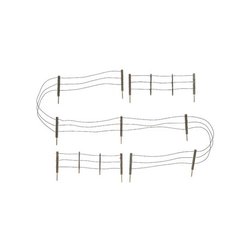
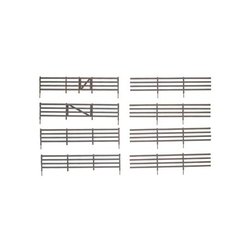
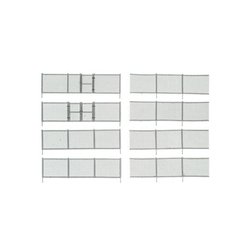
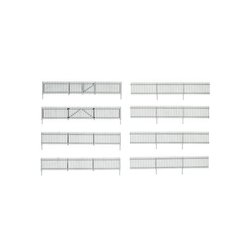
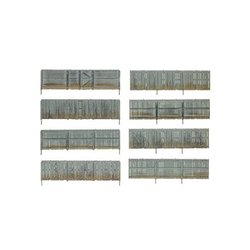
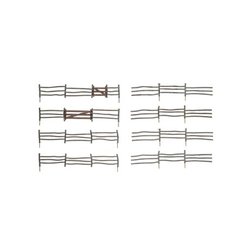
Once you have installed your fences, you may want to season them a little or add interest by applying a little vegetation around the base or installing some street furniture, here are just a few ideas to take your fences to the next level.
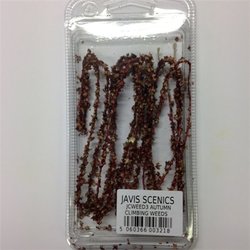
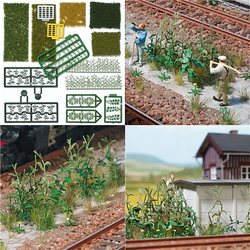
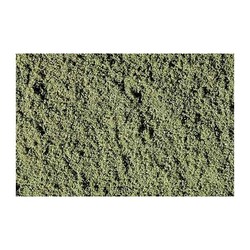
As fences get older they often acquire growth in the form of grass, foliage or weeds growing around their base, especially if the fence is in the countryside or an industrial area where upkeep is periodic or sporadic. There are several ways that you can achieve this unloved effect by using one or a combination of turfs with a dense consistency to emulate weeds. You could take the detail a step further by incorporating some actual model weeds such as the "bad weeds" or "wild weeds and flowers" sets from Busch and maybe add some climbing weeds too. Climbing weeds come in long strips that can be used as full-length features or cut shorter to suit your individual needs.
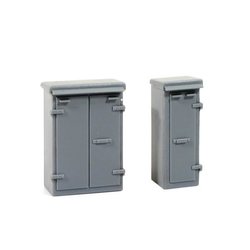
Another great way to add interest and realism to your fencing is to install some telegraph poles, we are accustomed to seeing them at the side of railway lines, but a lot of roads and lanes have them too, and on a country lane they are usually buried in the hedgerow or planted along the fence-line. The poles can carry telephone wires or electricity cables and usually take on a slightly different appearance to the traditional railway variety. The example below is a depiction of some wooden telegraph poles with four straight poles and a fifth with a side-support and if you are including electrical installations then don't forget a relay or junction box.
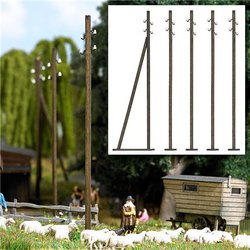

- What is a tare weight?
- What is a Felix Pole wagon?
- What is a Eduard Profipack kit?
- Should I use AC or DC to power my CDU?
- Can you get decals for all gauges of model railway rolling stock?
You can access all the unboxing videos by visiting this page or simply click on the link called "videos" on our website.
Do you need to order?
Send us an email or give us a call to check availability or to reserve anything, whatever scale you model in. As usual, if we do not have in stock what you are looking for, we will order it for you and you will get it fast (usually within a week if the manufacturer has it in stock). We place weekly orders with most suppliers.
Remember, you can park for free for one hour on the High Street. So no excuse not to come and visit us!
Upstairs Downstairs is open Tuesday to Saturday 10am till 4.30pm. Obviously, our website is open 24h a day and we can post to most locations, including Europe, USA and Australia.
Upstairs Downstairs
3 Pier Street
Sandown, PO36 8JR
Isle of Wight
Tel: 01983 406 616
http://www.trainshop.co.uk or find us on Facebook
If for some reason you do not want to receive this newsletter anymore, click this link to unsubscribe